L1 Visa Lawyer for Transfers
In today's global chess game of international commerce, the capacity to position qualified personnel where they're needed at the optimal time is a crucial advantage. For multinational organizations, the L-1B visa functions as the specialist's gateway-a vital instrument for transferring staff with distinctive capabilities to the United States. This visa category is created for professionals who possess "specialized knowledge" that is essential to the company's operations, products, or services. However, the concept "specialized knowledge" remains one of the most challenging and heavily scrutinized elements in U.S. immigration law. This resource aims to clarify the L-1B visa, offering a detailed framework for organizations and professionals aiming to employ this valuable pathway. With the guidance of a seasoned L1 immigration attorney, the L-1B visa can open up new avenues for expansion and advancement in the American market.
Key Takeaways
- An L-1B visa is a specialized copyright for professionals with L-1B specialized knowledge that is essential for the company's success.
- It represents a key part of the multinational company transfer program, allowing businesses to utilize their internal talent pool for United States-based activities.
- Different from the executive transfer visa (L-1A), the L-1B centers on an employee's specialized knowledge and capabilities instead of their executive functions.
- Showing specialized understanding is a significant evidentiary requirement, rendering the support of an L1 visa lawyer vital for creating a successful application.
- A knowledgeable L1 immigration attorney is your best resource while managing the complexities of the L-1B petition, particularly with handling complex Requests for Evidence (RFEs).
- While the L-1B has a five-year limit, it can act as a stepping stone to a copyright, and an legal expert can guide you in developing a strategy for this long-term objective.
The Multinational Company Transfer: Powering Global Business Operations
The L-1 visa system operates as the backbone of global business, facilitating the smooth movement of talent for a multinational company transfer. It permits organizations to move essential staff from their overseas locations to a subsidiary, affiliate, parent, or branch office in the United States. This corporate relocation process is crucial for sustaining corporate culture, sharing institutional knowledge, and implementing global business strategies. The L-1 visa is divided into two separate categories: the L-1A for executives and managers, and the L-1B for specialists with unique expertise. Though both categories fulfill the larger goal of promoting international business, they possess different eligibility criteria and strategic implications. Comprehending the details of this program is the first step for any business seeking to grow its footprint in the U.S., and it's a journey best managed with the assistance of an experienced immigration lawyer.
The Cornerstone of Your L-1B Case: Defining L-1B Specialized Knowledge
The basis for any L-1B visa petition rests on one key, challenging, and frequently debated element: L-1B specialized knowledge. This terminology is not simple to interpret, and how it's understood by U.S. Citizenship and Immigration Services (USCIS) has changed over time. As defined by USCIS, specialized knowledge refers to specific knowledge an employee has that is exceptional and particular to the applying entity's operations, methodologies, technologies, processes, management practices, or other core aspects. It represents knowledge that is not commonly found within the industry or that cannot be easily transferred to another individual without considerable investment or organizational disruption. Establishing the existence of specialized knowledge needs to clear a high evidentiary threshold. It necessitates a comprehensive and convincing presentation that the employee's knowledge and capabilities are authentically special, proprietary, and vital to the company's U.S. operations. This is when the expertise of an L1 visa lawyer is crucial in developing a compelling and thorough case.
The Executive's Path: A Guide to L-1A Transfer Visas
To thoroughly grasp the special qualities of the L-1B visa, it proves beneficial to contrast it with its executive counterpart, the L-1A visa. The L-1A is an executive transfer visa designed for executives and managers who will be overseeing the administration of the organization or a key division. The focus of the L-1A is on the individual's senior-level managerial or executive duties and their ability to take action and guide the work of others. In contrast, the L-1B centers on the specialized nature of the individual's knowledge, irrespective of their position in the corporate hierarchy. While an L-1A beneficiary manages the team, the L-1B beneficiary is typically the indispensable technical expert or specialist on that team. Grasping this differentiation is vital for choosing the correct visa category and for developing a successful petition, as the evidentiary requirements for each are distinctly different.
Creating an Ironclad Case: How an L1 Visa Lawyer Proves Professional Expertise
Establishing the existence of L-1B specialized knowledge is both an art and a science, and it is a task best entrusted to a experienced L1 visa lawyer. A effective petition needs comprehensive evidence built on comprehensive conclusive evidence and strong legal justification. An skilled lawyer collaborates closely with the organization and worker to identify and articulate the specific knowledge that sets the employee apart. This involves a deep dive into the company's proprietary processes, technologies, and business practices. The lawyer assembles a comprehensive set of evidence to support the claim, which could encompass patents, internal training materials, project documents, and letters of support from senior executives. The goal is to create a clear and compelling case for the USCIS adjudicator, showing that the candidate's skills is beyond useful, but absolutely crucial to the U.S. operation's growth. This meticulous case-building is the signature of a top-tier L1 immigration service.
The Road to Success: Breaking Down the L-1B Application Process
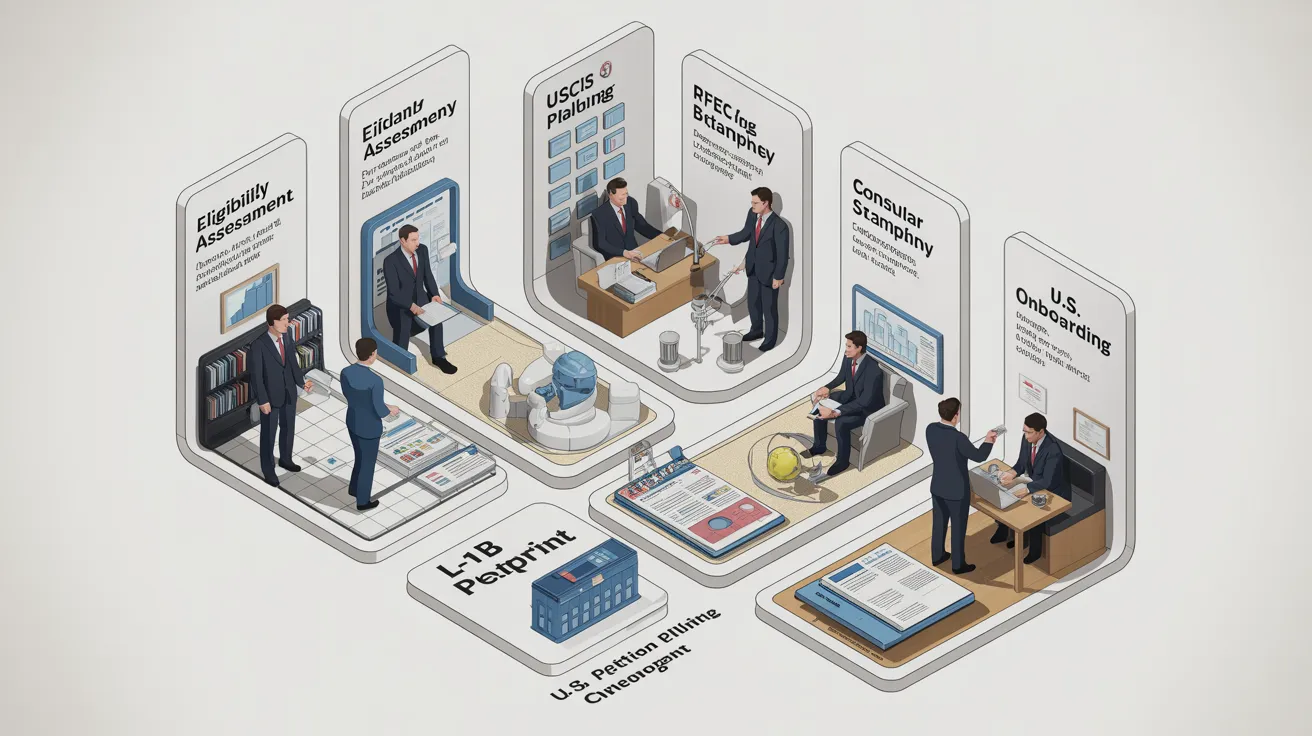
Handling the L-1B application process is similar to using a detailed blueprint for success. With the support of an L1 immigration attorney, the process can be organized into a series of manageable steps. It begins with a comprehensive eligibility assessment of both the company and the employee. This is succeeded by the strategic preparation of the petition, which encompasses the collection of all necessary documentation and the drafting of the legal arguments. Once the petition is registered with USCIS, there is a period of adjudication, during which the government examines the case. If USCIS needs additional information, they will issue a Request for Evidence (RFE), which must be answered in a prompt and thorough manner. Upon acceptance of the petition, the employee can then pursue their L-1B visa at a U.S. consulate or embassy abroad. The last phase is the visa interview, after which the employee can come to the U.S. and begin their assignment.
Your Advocate in a Complex System: The Role of an L1 Immigration Attorney
The United States immigration process constitutes a complicated and demanding administrative process. An L1 immigration attorney acts as your advocate, your guide, and your champion in this framework. Their role is not just to file paperwork; they deliver expert guidance and to foresee and resolve potential issues. Throughout the entire process, from first evaluation to visa approval, a seasoned legal professional will guide you, making certain your application is optimally positioned. They will help you navigate the detailed administrative rules, ready you for immigration officer review, and address any complications that emerge. Given that any mistake could cause significant delays or application denial, the value of a dedicated legal advocate cannot be overstated.
Managing Setbacks: RFEs and Denials
Getting a Request for Evidence (RFE) or rejection on an L-1B petition is often a considerable setback, but it is not necessarily the end of the process. This marks a critical moment where the knowledge of an L1 immigration attorney is most crucial. An experienced attorney will thoroughly examine the RFE or denial notice to understand the government's position and to determine the specific areas of concern. They will then work with you to develop a strategy for responding to the RFE or for appealing or refiling the case in the instance of a denial. A thorough RFE response or appeal demands not just additional evidence, but also a compelling legal argument that effectively responds to the government's concerns. With the right legal strategy, it is frequently achievable to overcome these hurdles and secure a successful outcome.
Understanding the Blanket L-1: A Simplified Path for Qualifying Companies
When it comes to major international companies, the Blanket L-1 program provides a streamlined and efficient solution for relocating employees to golden visa UAE requirements the United States. After obtaining an approved Blanket L petition, they can relocate employees, including those with L-1B specialized knowledge, eliminating the need to file an individual petition with USCIS for each employee. Alternatively, the employee can apply for their L-1B visa immediately at a U.S. consulate or embassy abroad. This can significantly reduce administrative overhead and processing delays. To qualify for the Blanket L program, a company must satisfy certain operational and scale criteria. An experienced L1 visa lawyer can guide a company on whether they are eligible for this program and can support the completion and filing of the Blanket L petition.
Navigating Life in America: L-1B Status Privileges and Limitations
Life in the United States on an L-1B visa features a distinct set of rights and limitations. The fundamental right is the ability to work and reside in the U.S. for the petitioning employer. L-1B visa holders are also able to bring their spouse and unmarried children under 21 with them on L-2 dependent visas. A notable benefit is that L-2 spouses are eligible to apply for work authorization, enabling them to work for any employer in the U.S. However, there are also restrictions. The L-1B visa has a cap of five years, and after this period expires, the individual must typically depart the U.S. for at least one year before they can be eligible for a new L or H visa. It is also essential to remember that the L-1B is a non-immigrant visa, and holders must keep an intent to leave the U.S. upon the termination of their status.
Transitioning from L-1B to copyright: A Specialist's Journey
Although the L-1B visa is classified as a temporary, non-immigrant visa, it operates as a important stepping stone from specialist to resident. Many L-1B holders, the final target is to gain permanent residency (a copyright) in the United States. Though the L-1B isn't equipped with a direct path to a copyright like the executive transfer visa (L-1A) provides, there are still practical pathways. An L-1B holder can potentially qualify for a copyright through the PERM labor certification process, where their employer endorses them for permanent residency. Otherwise, if the L-1B holder is promoted to a managerial or executive position, they might become eligible to file for a copyright under the EB-1C category. An experienced L1 immigration attorney can provide invaluable strategic guidance on the best pathway to a copyright depending on the individual's unique circumstances and career trajectory.
Questions and Answers
How is L-1B specialized knowledge legally defined?
The official interpretation of L-1B specialized knowledge is complicated and requires interpretation by USCIS. USCIS characterizes this as knowledge that is specialized and unique to the petitioning organization's products, technologies, procedures, systems, management practices, or core competencies. It must be knowledge that is not commonly held within the industry and that cannot be easily transferred to another individual without considerable resources or time investment. Demonstrating that a worker's expertise satisfies these requirements demands comprehensive evidence and an in-depth analysis of why their skills are unique and essential to the company. An L1 visa lawyer is crucial for building a case that successfully proves this qualification.
What makes the L-1B visa distinct from the H-1B visa?
The L-1B and H-1B visas are both non-immigrant work permits, but they have several key differences. The L-1B is an intracompany transfer visa that requires the employee to have been employed with a related foreign entity for at least one year before entering the U.S. The H-1B specifically serves professionals in specialized fields and has no requirement for prior employment with a related foreign company. The H-1B is subject to an annual cap, making it a lottery-based system, whereas the L-1B isn't subject to annual quotas. For the L-1B, specialized company-specific knowledge is essential, but the H-1B demands a bachelor's degree or its equivalent in a specific field.
Is it possible to switch employers with an L-1B visa?
No, the L-1B visa is employer-specific. This means you are only authorized to work for the company that sponsored your L-1B petition. Changing employers requires a new company to file a separate visa petition in your name, for example, an H-1B or other appropriate visa type. You cannot simply transfer your L-1B status to a new, unrelated company. This is a key difference from some other visa categories and an important consideration for L-1B visa holders.
What happens if my L-1B petition is denied?
If your L-1B petition gets rejected, your L1 immigration attorney will carefully review the denial notice to determine the basis for the decision. According to the circumstances, you could explore several options. You can potentially file a petition to reassess the case if you conclude there was a legal error in the decision. Alternatively, you could file an appeal with the Administrative Appeals Office (AAO). Sometimes, the best strategy could be to refile the petition with supplementary documentation that responds to the problems raised in the denial. An qualified attorney can guide you determine the optimal path forward.
Can L-1B visa holders qualify for a copyright?
Yes, you can to secure a copyright while on an L-1B visa, though there is no direct path. The most common route is through employer sponsorship via the PERM labor certification process. This necessitates the employer showing that there are no qualified U.S. workers suitable for the position. Another potential pathway is when the L-1B employee moves into a managerial or executive position within the company. In this case, they could become eligible to pursue a copyright under the EB-1C category for multinational managers and executives, which doesn't need a labor certification. A knowledgeable L1 visa lawyer can provide guidance on the best long-term immigration strategy.